You found the perfect nursing role, so you spent hours on your CV, aiming to make it perfect. You tailored your application, double-checked every detail, and hit submit. Then nothing.
No email. No call. No interview.
This is the experience of thousands of nursing applicants every year. Not because you lack qualifications or chose the wrong role. But because your personal statement looked like everyone else's.
This guide fixes that. And to make it easier for you, we have it done it practically by following one applicant, Amara Ogoye, from a blank page to a finished personal statement that works. Every piece of advice here comes with her real example attached so you can see exactly how it translates in practice.
By the end, you will know what selectors actually look for, how to structure every paragraph, which mistakes kill applications, and how to write something only you could have written.
Why Your Personal Statement Matters More Than You Think
Before you write a single word, it is important to understand the level of competition you are facing.
Nursing programmes receive thousands of applications every year from candidates with strong grades, relevant experience and genuine passion for healthcare. Many applicants meet the academic requirements, which means admissions teams need other ways to identify who stands out.
That is where your personal statement becomes important.
Your personal statement is the one part of your application that allows admissions tutors to see the person behind the grades. It gives you the opportunity to explain why you want to become a nurse, what experiences have shaped your decision, and what qualities you would bring to the profession.
Many applicants assume their grades will secure them a place. In reality, strong academic results are often only the starting point. Admissions teams regularly review applications from candidates with similar qualifications, making the personal statement one of the key factors that can influence who receives an interview invitation.
A Duke University School of Nursing admissions director has noted that many applicants arrive with strong academic records, making the personal statement an important opportunity for differentiation.
Your grades may help open the door, but your personal statement helps convince admissions tutors that you deserve the place waiting on the other side.
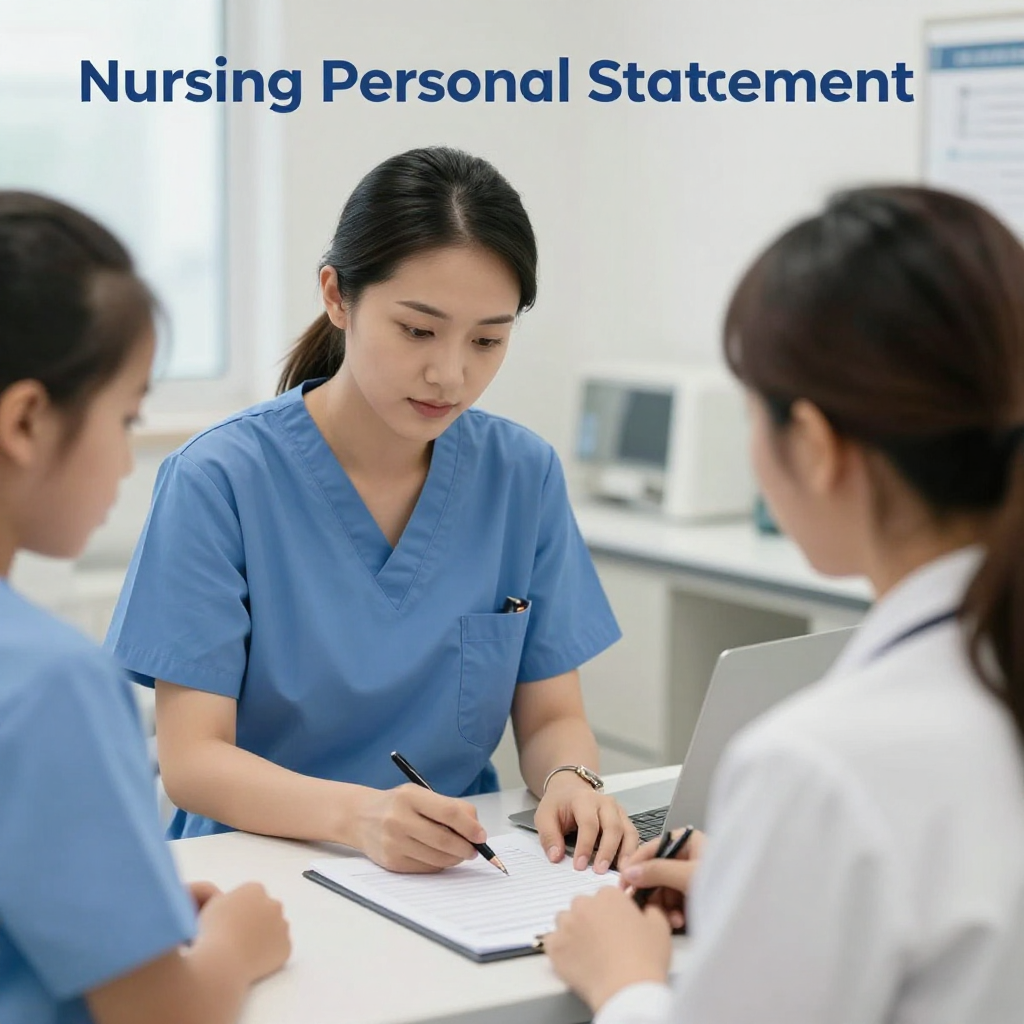
What Is a Nursing Personal Statement?
A nursing personal statement is a written account of who you are, why you want this specific role or programme, what skills and experience you bring, and why you are the right fit.
It is used across a wide range of applications, including NHS job applications, hospital and care home roles, community nursing positions, university nursing programmes (undergraduate and postgraduate), and international nursing applications to the UK.
Recruiters and selectors use it to assess:
-
Clinical competence
-
Compassion
-
Professionalism
-
Communication skills
-
Teamwork
-
Genuine understanding of patient care
They are not reading for impressive vocabulary. They are reading for evidence.
Meet Amara: Building a Personal Statement From Scratch
Instead of abstract advice, we are going to follow Amara Ogoye through every step of writing her nursing personal statement.
Amara Ogoye is 24 years old, from Lagos, Nigeria. She is applying to a BSc Adult Nursing programme in the UK. She holds a Diploma in Health Sciences, spent two years as a community health volunteer, and spent eight months as a paid carer for an elderly neighbour. English is her second language.
Amara has solid experience. She is genuinely motivated. But when she first sits down to write, here is what comes out:
"My name is Amara Ogoye and I am applying to study nursing because I have always wanted to help people. I have experience in healthcare and I believe I have the skills needed to be a good nurse. I am hardworking and dedicated..."
This is the most common starting point. It is honest, well-intentioned, and it will get her application set aside.
Not because Amara lacks the right qualities. It is because she has not yet learned how to show them. That is exactly what we are going to fix.
What Selectors Are Actually Looking For
Selectors are not marking essays, they are trained to look for four specific things. Understanding these before you write changes everything you put on the page.
1. Genuine and Specific Motivation
They want to know why nursing, not medicine, physiotherapy, or social work. And they want to hear it from a real moment in your life, not a general statement about caring. UCAS (the Universities and Colleges Admissions Service) advises applicants to connect personal experiences directly back to nursing values rather than making broad claims.
Amara's real motivation is not a desire to help people. It is a specific memory.
When her younger brother Emeka was hospitalised with typhoid fever at age nine, Amara spent every evening at that hospital. She watched the doctors make efficient rounds. But it was the nurses who stayed.
One nurse, Sister Ngozi, sat beside Emeka when he cried at night, explained his treatment to their mother in plain language. Then showed Amara how to change his dressing so she could feel useful rather than helpless.
That is her motivation.
That specific moment.
Not a category.
2. Evidence Of Relevant Experience
Experience does not have to mean formal clinical work. Caring for a family member, community volunteering, and customer-facing roles that required empathy under pressure all count.
The key is reflection: selectors want to see what you learned, not just what you did.
Amara's relevant experience includes:
-
Two years as a community health volunteer in Lagos
-
Conducting home visits for elderly residents with chronic conditions
-
Monitoring medication compliance
-
Escalating deteriorating patients to clinic staff
-
Eight months as a paid carer for an elderly neighbour recovering from a hip replacement
3. Core Nursing Values Demonstrated Through Action
In UK nursing contexts, selectors look for evidence of the 6 Cs:
-
Care
-
Compassion
-
Competence
-
Communication
-
Courage
-
Commitment
But you do not need to name them. You need to show them through the stories you tell.
Amara has a moment that does exactly this.
During her community health volunteering, she visited an elderly man, Mr Adeyemi, whose blood pressure readings had been consistently high despite a prescribed medication schedule.
Her first instinct was to reinforce the importance of medication. But something in the way he spoke made her slow down. She asked more questions. She discovered he had been rationing his tablets because he could not afford both medication and food that week.
She escalated this to the supervising nurse, who arranged a welfare referral.
His readings stabilised within a month.
That experience taught her that clinical observation is only half of patient assessment. The other half is listening without assuming you already know the answer.
4. Reflective Thinking
Nursing is a reflective profession by design.
Every clinical placement involves structured reflection. Showing that you can look at an experience, identify what it taught you, and connect it to future practice signals that you will thrive in training. It is not just good writing. It is the right kind of thinking.
Before You Write: Analyse the Role
The biggest mistake applicants make is writing about themselves without connecting their experience to the role they are applying for.
Recruiters are asking three questions:
A. Can this person do the job?
Do they have the skills, experience and qualifications the role requires?
B. Will they fit our team?
Do they demonstrate the values, communication style and professional approach that will work in our environment?
C. Do they understand what this role actually involves?
Not what they imagine nursing to be, but what it genuinely demands day to day.
Your statement has to answer all three.
That is where step 1 begins.
Step 1: Read the person specification
Look for essential criteria, desirable criteria, and required qualifications. These are not suggestions. They are the exact things selectors are screening for.
Step 2: Highlight keywords
Keyword examples include patient-centred care, communication, leadership, safeguarding, teamwork, and clinical skills.
Step 3: Build a skills-matching list
Before you write a word, create a simple two-column table as shown below.
|
Job Requirement |
Your Evidence |
|
Communication |
Explained treatment plans to families in plain language during community health visits |
|
Teamwork |
Coordinated with clinic staff to escalate patient welfare concerns |
|
Compassion |
Supported patients experiencing anxiety before procedures |
|
Resilience |
Managed personal care for a dependent patient who was often frustrated and distressed |
|
Clinical awareness |
Monitored chronic condition management across multiple patients over two years |
Remember: This table becomes the foundation of your statement. Every paragraph should draw from it.
The Five-Part Structure: Paragraph by Paragraph
Most strong nursing personal statements use a five-paragraph structure across 600 to 800 words. Here is how the word count breaks down and what belongs in each section.
|
Paragraph |
Purpose |
Approximate Words |
|
1 |
Opening hook and stated motivation |
80 |
|
2 |
First experience and what you learned |
160 |
|
3 |
Second experience or transferable skill |
140 |
|
4 |
Academic background and programme fit |
130 |
|
5 |
Future vision and closing |
100 |
Paragraph 1: The Opening Hook
Your first sentence is the most important sentence in the document. Admissions officers at competitive programmes are explicit about this. That first sentence needs to pull the reader in. It must be specific to you.
Do not open with "I have always wanted to be a nurse." Or "Nursing is a rewarding and challenging profession." These sentences have been written hundreds of thousands of times.
Open with a specific moment that only you experienced. Make the reader feel they are already in the story.
Here is what Amara's opening paragraph looks like when it is built from her real memory, not from a template:
I was thirteen years old when my brother Emeka was hospitalised with typhoid fever. I watched the doctors make their rounds quickly and efficiently, but it was the nurses who stayed. Sister Ngozi sat beside him when he cried at night, explained his treatment to our mother in words she could actually understand, and showed me how to change his dressing so I could feel useful rather than helpless. That week shaped the way I understand healthcare: not as a series of interventions, but as a sustained human presence around a person who is frightened. I have spent the last four years building the knowledge and experience to become that presence for others.
Notice what this paragraph does.
It places the reader inside a real scene. It distinguishes nursing from medicine in a specific and grounded way. It states Amara's motivation without once saying "I want to help people." And it closes with a confident statement of readiness.
Paragraph 2: Your First Experience and What You Learned
This is where you prove that your motivation is backed by real-world engagement. Choose your most significant experience and use it to show a specific nursing value in action.
The formula is simple:
-
Describe what you did
-
Name one specific moment or challenge
-
Write what it taught you
For every experience you mention, spend at least as many words on the reflection as on the description. Selectors are not interested in what happened. They are interested in what you took from it.
Here is how Amara applies this to her community health volunteering and Mr Adeyemi:
During two years as a community health volunteer in Lagos, I conducted regular home visits to elderly residents managing chronic conditions including hypertension and diabetes. One visit fundamentally changed how I think about patient compliance. I was visiting a 71-year-old man whose blood pressure readings had been consistently high despite a prescribed medication schedule. My first instinct was to reinforce the importance of the medication. But something in the way he spoke made me slow down and ask more questions. I learned that he had been rationing his tablets because he could not afford both medication and food that week. I escalated this to the supervising nurse, who arranged a welfare referral. His readings stabilised within a month. That experience taught me that clinical observation is only half of patient assessment. The other half is listening without the assumption that you already know the answer.
Paragraph 3: Your Second Experience or Transferable Skills
Your second experience paragraph should show a different side of you.
If your first experience demonstrated empathy and communication, use this one to show something else entirely. Resilience under pressure. Practical clinical competence. Attention to detail in documentation. The ability to work effectively within a team.
The goal is not to list everything you have done. It is to show the admissions team that you bring more than one quality to nursing, and that each quality is grounded in something real.
Here is how Amara draws on her eight months as a paid carer:
Alongside my volunteering, I worked for eight months as a private carer for an elderly neighbour recovering from a hip replacement. This role required me to manage personal care, medication schedules, and mobility support while maintaining the dignity of someone who found dependence deeply difficult. There were days when she was frustrated and short with me, and I learned to separate her distress from her words, to respond to what she needed rather than what she said. I also developed a practical discipline around recording observations clearly and flagging changes in her condition to her supervising GP. This attention to documentation, something I initially underestimated, has made me genuinely curious about the clinical governance systems I will encounter in training and how they keep patients safe.
Paragraph 4: Academic Readiness and Programme Fit
Show the selector that you have done your research and that this is not a generic application. Mention relevant academic preparation and connect it specifically to what the programme offers.
For international applicants like Amara, this paragraph is also where you show awareness of the different healthcare context you are entering. Do not ignore the transition. Address it, own it, and frame it as a strength while demonstrating that you understand what adapting will actually require.
My Diploma in Health Sciences gave me a foundation in anatomy, physiology, and basic pharmacology that I am eager to deepen through degree-level study. I am particularly drawn to this programme's emphasis on evidence-based practice and its integrated placement model, which exposes students to a range of clinical settings from the first year. As someone transitioning from a healthcare context where resources are limited and community-based care carries significant weight, I believe I bring a perspective that is both practically grounded and alert to the social determinants of health. I am fully aware that the NHS context will require me to adapt, learn new systems, and build new professional relationships. I welcome that challenge rather than approaching it as a barrier.
Paragraph 5: Future Vision and Closing
End with purpose and direction. You do not need a detailed five-year plan. You need to show that you have thought beyond acceptance: what kind of nurse you want to become, and why this programme is the right place to begin that journey.
Do not close with "I hope to be considered." Close with where you are going and why this programme is the right vehicle to get you there.
My longer-term ambition is to work in community or public health nursing, ideally in settings that serve under-represented populations. My background has shown me how much health outcomes depend on factors that happen outside hospital walls, and I want to be part of a nursing workforce that engages with those realities rather than treating them as someone else's problem. I am applying to this programme because I believe it will give me the clinical rigour, the reflective practice, and the professional grounding to become the kind of nurse who makes a difference not just in individual consultations but also in the communities those consultations are embedded in.
Common Mistakes That Cost Interviews
Mistake 1: Opening With Your Name Or A Generic Statement
Amara's first draft started with "My name is Amara Ogoye and I am applying to study nursing because I have always wanted to help people." Her revised version starts with Emeka's hospital room. The difference in engagement is immediate.
Mistake 2: Listing Experiences Without Reflection
A weak version of Amara's paragraph 2 would say: "I volunteered as a community health worker and also worked as a private carer. These roles gave me relevant experience." That tells the selector nothing they could not infer from her CV. The strong version unpacks one specific moment, the conversation with Mr Adeyemi, and draws a clear lesson from it.
Mistake 3: Failing To Address Being An International Applicant
Pretending your background is irrelevant is a missed opportunity. Selectors notice the gap between where you trained, where you are applying, and if you do not address it, they wonder whether you have thought about the transition at all.
Amara directly names the context shift and frames her international experience as an asset, while showing she understands adaptation is required. That is far more compelling than silence.
Mistake 4: Using The Same Statement Everywhere
A statement written for one role or programme rarely works unchanged for another. Selectors know when something has been copied and pasted. The person specification exists to tell you exactly what they need. Use it.
Mistake 5: Making Claims Without Evidence
"I have excellent communication skills." Every applicant says this. None of them prove it. Replace every claim with a moment.
Show, do not tell.
Mistake 6: A Weak Or Passive Closing Paragraph
"I hope to be considered for this programme and I look forward to developing my skills as a nurse" tells the selector nothing about who you are or where you are going.
Amara's closing paragraph names a specific area of nursing, explains the motivation behind it from her lived experience, and closes with a confident statement of what she will bring to the role.
That is the difference between forgettable and shortlisted.
Mistake 7: Long Paragraphs And Weak Grammar
Readability matters.
Recruiters reading 200 statements in a day will not work hard to follow dense, unbroken text. Short sentences. Active voice. One idea per paragraph.
And always proofread, twice.
Words That Strengthen a Nursing Personal Statement
Strong action verbs make your experience concrete and your writing active. Use these throughout:
|
Action Verbs |
What They Convey |
|
Assessed, monitored, identified |
Clinical observation |
|
Collaborated, coordinated, communicated |
Teamwork and communication |
|
Escalated, flagged, advocated |
Professional judgement |
|
Supported, reassured, educated |
Compassionate care |
|
Prioritised, managed, implemented |
Competence under pressure |
|
Documented, recorded, reported |
Clinical governance awareness |
Avoid passive constructions like "I was responsible for" or "I was involved in." Say what you did. "I conducted home visits" is stronger than "I was involved in community health work."
Then, before you submit, use these as your final checklist:
-
Does the first sentence put the reader inside a real moment? Would a selector who has read 200 statements remember it?
-
Have you named at least two specific experiences, not just job titles or roles?
-
For each experience, have you written what it taught you, not just what you did?
-
Have you avoided "I have always wanted to help people" or any phrase a thousand other applicants would write?
-
Does the statement mention something specific about this programme, not just nursing in general?
-
If you are an international applicant, have you addressed the context shift and framed your background as a strength?
-
Is the final paragraph forward-looking and confident, not passive or apologetic?
-
Have you read it out loud? Awkward sentences to say are awkward to read.
-
Has someone who knows you confirmed it sounds like your voice?
-
Is it within the word limit? Are there sentences you could cut without losing meaning?
Final Thoughts
Amara's first draft was indistinguishable from thousands of others.
Her finished statement is something only she could have written.
The difference was not talent or perfect English or an impressive CV. It was specific.
She found Emeka's hospital room. She found Mr Adeyemi and what she learned sitting in his kitchen. She found the days frustrating with her neighbour and what they taught her about dignity and documentation.
Therefore, your statement starts in the same place. Find your version of those moments. Write from there. That is where the interview begins.
Ready to write a personal statement that gets you an interview?UKNurses supports nurses at every stage, from writing a standout personal statement to building the skills that get you hired.
Ready to get started? Get in touch with UKNurses today.
Frequently Asked Questions
1.How long should a nursing personal statement be?
For most university nursing applications in the UK, UCAS sets a limit of 4,000 characters or 47 lines, whichever comes first. For job applications, follow the word limit stated in the person specification. If no limit is given, aim for 600 to 800 words. Longer is rarely better.
2. Can I use the same personal statement for multiple applications?
You can use the same structure, but you should tailor each statement to the specific role or programme. Selectors know when something is generic. Reference the organisation's values, the specific programme structure, or the department you are applying to. Even one targeted paragraph makes a significant difference.
3. What if I do not have clinical experience?
Caring for a family member, volunteering, customer service under pressure, teaching, or any role requiring sustained empathy and communication all count as relevant experience. The key is reflection: what did it teach you, and how does it connect to nursing?
4. Should I mention that I am an international applicant?
Yes. Ignoring it does not make it invisible. Selectors see the gap between where you trained and where you are applying. Address it directly, frame your international background as an asset, and show you understand what the transition will require. That is far more effective than hoping they will not notice.
5. How do I avoid sounding like everyone else?
Write from specific moments, not categories. "I have always wanted to help people" sounds like everyone else because it is a category. "I watched Sister Ngozi explain a treatment plan to a frightened mother in the corridor at midnight" is a moment. Moments are specific. Specificity is what selectors remember.